How to Select a Pallet Truck: A Practical Buying Guide
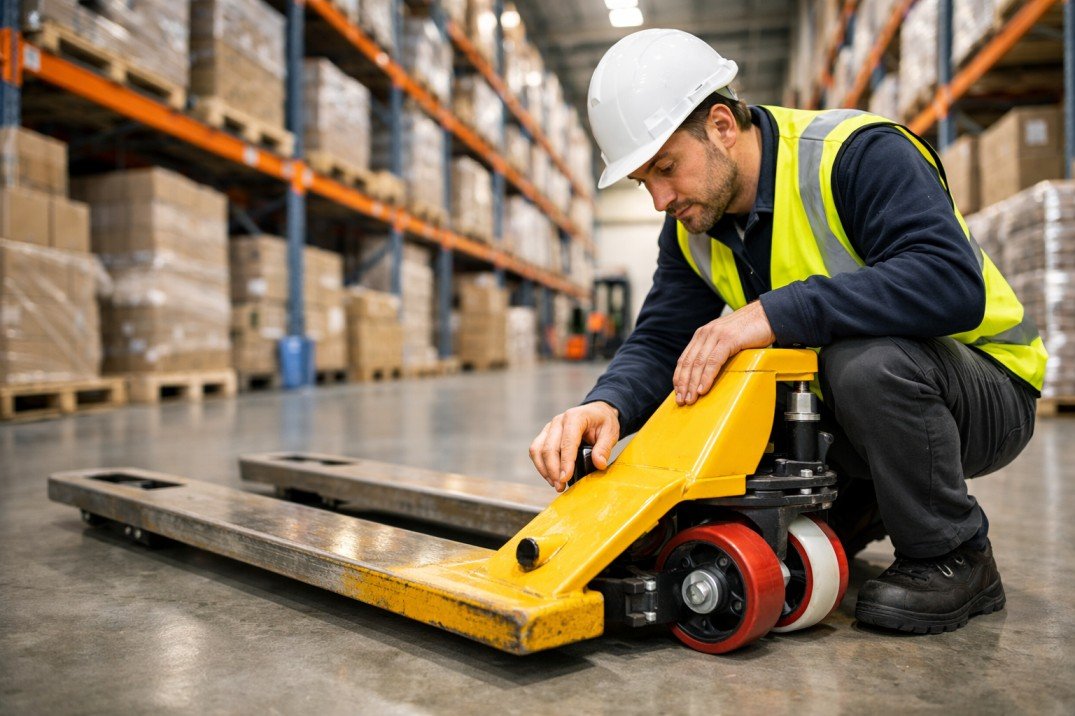
A pallet truck may look like a simple purchase—until it struggles to move a loaded pallet or its forks do not fit the pallets in your warehouse.
The right equipment makes everyday material movement easier. The wrong choice can increase handling effort, interrupt work and lead to unnecessary repairs.
To select a pallet truck, start with your heaviest loaded pallet, measure the pallet openings and check your floor conditions. Then consider travel distance, frequency of use and the space available for turning.
This guide explains what to check before buying a pallet truck for your warehouse, factory or dispatch area.
1. Choose the Right Pallet Truck Capacity
Pallet truck capacity is the maximum rated load the equipment can handle under the manufacturer’s specified conditions.
Start with the total weight being moved. Include:
- The goods or materials.
- The pallet itself.
- Containers, wrapping and other packaging.
For example, if your goods weigh 1,400 kg and the pallet and packaging add another 50 kg, your handling requirement is 1,450 kg.
Choose equipment rated for that load and its distribution. Allow for realistic changes in your operation, but remember that a higher capacity rating alone does not make a truck suitable for every application.
Look beyond the weight
A load can be within the rated capacity and still be difficult to handle if it is uneven, unstable or poorly supported.
Tell your supplier if you move long components, machinery or loads with an offset centre of gravity. Confirm suitability against the model’s specifications.
Also consider how much effort operators need to start, steer and stop the loaded truck. A manual pallet truck’s lifting capacity does not tell you whether repeated movement will be practical throughout a shift.
2. Match the Fork Size to Your Pallets
Fork dimensions are just as important as load capacity. A truck that lifts enough weight is of little use if it cannot enter the pallet correctly.
Measure your actual pallets rather than relying only on descriptions such as “standard pallet.”
Fork length
The forks must provide appropriate support beneath the pallet without creating problems during positioning.
Forks that are too short may provide inadequate support. Forks that extend too far can interfere with nearby pallets or equipment.
Check the pallet depth in the direction from which the truck will enter.
Overall fork width
Overall fork width means the distance across the outside edges of both forks. This differs from the width of each individual fork.
Check that both forks align with the pallet openings and clear the pallet’s internal supports.
Lowered fork height
The forks must fit beneath the pallet when fully lowered. Low-clearance pallets may require a low-profile pallet truck.
Manufacturer specifications list fork length, overall width and lowered height separately because each affects compatibility. These dimensions vary between models.
Practical buying tip: Send your supplier a photograph of the pallet, its dimensions and the intended entry direction. If possible, test the truck with a representative loaded pallet before ordering.
3. Select Wheels for Your Floor Conditions
Pallet truck wheels affect rolling effort, noise and handling. Choose them according to the surface and working environment.
A truck travelling across smooth concrete faces different conditions from one crossing joints, thresholds or sensitive flooring.
| Wheel material | Where it may suit | What to check |
|---|---|---|
| Nylon | Hard, smooth and even floors where easy rolling matters | Noise, floor compatibility and surface joints |
| Polyurethane (PU) | Indoor areas where quieter movement is useful | Rolling effort under load and the specific wheel grade |
| Rubber | Applications where quiet travel and grip are priorities | Load rating, wear characteristics and availability for the model |
Manufacturer guidance identifies nylon as an easy-rolling option on hard, even floors, polyurethane as useful for lower noise, and rubber as a quiet option with good grip. Wheel performance still depends on the specific product and application.
Single or tandem load rollers?
Load rollers sit beneath the forks. Depending on the model, you may have single rollers or tandem rollers, also called bogie rollers.
Single rollers can suit smooth floors and manoeuvring. Tandem rollers distribute the load across more contact points and may travel more smoothly over minor unevenness.
Neither arrangement fixes damaged floors. Inspect the route for broken concrete, debris and abrupt changes in level before choosing equipment.
4. Decide Between Manual and Electric Operation
Your daily workload should guide this decision.
When a manual pallet truck may suit
A manual hand pallet truck can be practical when pallets move occasionally over short distances on suitable, level floors.
Consider it for tasks such as moving a pallet from a receiving point to a nearby storage position.
When electric assistance may help
Electric assistance is worth evaluating when operators move pallets repeatedly, cover longer distances or handle demanding loads throughout a shift.
Check exactly what the model powers. Some trucks provide powered travel, while others also provide powered lifting. Product descriptions alone may not explain the difference clearly.
For electric equipment, review battery runtime, charging arrangements and service support alongside load capacity.
5. Check Aisles, Turns and the Full Travel Route
A pallet truck must work throughout your facility, including its tightest corners.
Measure:
- The narrowest aisle and doorway.
- Space around storage positions.
- Turning areas near dispatch and receiving.
- Lift interiors or loading areas, where relevant.
- Thresholds and other changes in floor level.
Use the dimensions of the loaded pallet, including any overhanging goods, when assessing clearance.
If the route includes ramps, confirm that the specific truck is approved for the gradient and has suitable braking and operating arrangements. Do not assume every pallet truck is suitable for slope use.
6. Consider Maintenance and Spare Parts
Purchase price is only one part of ownership cost. A truck that is difficult to repair can disrupt work even when the original saving looks attractive.
Before buying, ask about:
- Replacement wheels, rollers, seals and bearings.
- Hydraulic pump servicing.
- Routine inspection requirements.
- Warranty terms and exclusions.
- Service availability in your location.
For electric models, also ask about battery replacement, charger support and electrical diagnostics.
Pallet Truck Buying Checklist
Use this checklist when requesting a quotation:
| Detail to share | What to provide |
|---|---|
| Maximum load | Total weight, including pallet and packaging |
| Pallet dimensions | Length, width, entry openings and underside clearance |
| Load characteristics | Evenly distributed, offset, fragile or unusually shaped |
| Floor conditions | Concrete, coated flooring, joints, thresholds or other surfaces |
| Usage | Approximate trips per shift and travel distance |
| Available space | Aisle widths, doorways and turning areas |
| Environment | Indoor, outdoor, cold storage, wet or washdown conditions |
| Operation preference | Manual or powered functions required |
These details help your supplier recommend equipment for the actual job.
Common Mistakes to Avoid
Buying on capacity alone. Fork fit, floor conditions and operator effort also determine whether a truck is suitable.
Assuming all pallets are the same. Check every pallet type used regularly in your facility.
Choosing wheels without inspecting the route. A wheel that works well on smooth flooring may behave differently across joints and rough patches.
Comparing only purchase prices. Include servicing, replacement parts and the effect of downtime.
Ordering without checking loaded clearance. The pallet and goods may need more turning space than the truck itself.
Frequently Asked Questions
What capacity pallet truck do I need?
Choose a truck rated for your maximum total load, including the pallet and packaging, under the manufacturer’s specified loading conditions. Confirm suitability for uneven or unusually shaped loads.
How do I choose the correct pallet truck fork size?
Measure the pallet depth, entry openings and underside clearance. Compare these with the truck’s fork length, overall fork width and lowered height.
Are nylon or PU wheels better for a pallet truck?
Nylon can suit hard, even floors where easy rolling matters. PU may suit indoor areas where quieter movement is important. The better choice depends on the floor, load and specific wheel specification.
Can one pallet truck handle different pallet sizes?
Sometimes, provided its fork dimensions, entry clearance and capacity suit each pallet type. Confirm compatibility with all regularly used pallets before buying.
Can a standard pallet truck stack pallets on racks?
A standard low-lift pallet truck is designed to raise pallets enough for horizontal transport. For placing loads onto racks, evaluate a suitable stacker or forklift.
Find the Right Pallet Truck for Your Facility
Selecting a pallet truck starts with understanding what you move, how often you move it and the route it follows.
Bharat Air Technologies’ BAIR SHIFT material handling range includes pallet trucks and other warehouse equipment.
Need help choosing? Share your pallet dimensions, maximum load, floor conditions and daily usage with our team. Contact Bharat Air Technologies to discuss a suitable option.
RECENT BLOGS