Industrial Air Pollution Control Systems: A Complete Guide for Modern Industries
Industrial growth supports manufacturing, infrastructure, employment, and economic development. However, industrial operations can also release dust, smoke, fumes, gases, and fine particles into the atmosphere. Without proper control measures, these pollutants can affect employee health, equipment performance, regulatory compliance, and the surrounding environment.
This is where industrial air pollution control systems become essential. These systems capture, filter, treat, or remove harmful airborne contaminants before they are released into the environment.
For modern industries, air pollution control is no longer only about compliance. It has become an important part of workplace safety, operational efficiency, sustainability, and responsible industrial growth.
What Are Industrial Air Pollution Control Systems?
Industrial air pollution control systems are specially designed equipment and technologies used to reduce harmful emissions generated during manufacturing and industrial processes.
They can control contaminants such as:
- Industrial dust
- Smoke and fumes
- Fine particulate matter
- Chemical vapours
- Oil mist
- Toxic gases
- Welding fumes
- Process exhaust
- Volatile organic compounds
- Suspended airborne particles
Depending on the industrial application, different pollution control technologies may be used individually or combined into a complete air filtration and emission control solution.
The main objective is simple: capture pollutants at or near their source and prevent them from entering the workplace or outside atmosphere.
Why Industrial Air Pollution Control Is Important
Industrial pollution can create several challenges if it is not controlled effectively.
1. Protects Employee Health
Workers exposed to dust, fumes, smoke, and chemical contaminants may experience respiratory irritation and other occupational health risks.
An effective industrial air filtration system helps maintain cleaner indoor air and creates a safer working environment.
2. Supports Environmental Compliance
Industries are required to follow applicable environmental and workplace air-quality regulations.
Proper pollution control equipment can help facilities manage emissions more effectively and support compliance with regulatory requirements.
3. Improves Equipment Performance
Dust and airborne contaminants can settle on motors, machines, electrical panels, bearings, and production equipment.
Over time, this contamination may increase maintenance requirements and reduce equipment performance.
Cleaner industrial environments can help protect valuable machinery.
4. Improves Workplace Cleanliness
Dust accumulation can make factories difficult to maintain.
A properly designed dust extraction or air pollution control system reduces airborne dust and helps keep manufacturing areas cleaner.
5. Supports Sustainability Goals
Modern businesses increasingly focus on reducing their environmental impact.
Controlling industrial emissions can support sustainability initiatives, responsible manufacturing practices, and long-term environmental goals.
Common Sources of Industrial Air Pollution
Different industries generate different types of contaminants.
Some common industrial processes associated with airborne pollution include:
- Welding and metal fabrication
- Grinding and polishing
- Cutting operations
- Foundry processes
- Material handling
- Cement manufacturing
- Chemical processing
- Pharmaceutical production
- Woodworking
- Powder handling
- Painting and coating
- Food processing
- Plastic manufacturing
- Automotive manufacturing
Identifying the pollution source is one of the most important steps before selecting an industrial air pollution control solution.
Types of Industrial Air Pollution Control Systems
There is no single pollution control system suitable for every application. The correct technology depends on the pollutant type, particle size, concentration, airflow requirements, temperature, and manufacturing process.
Dust Collection Systems
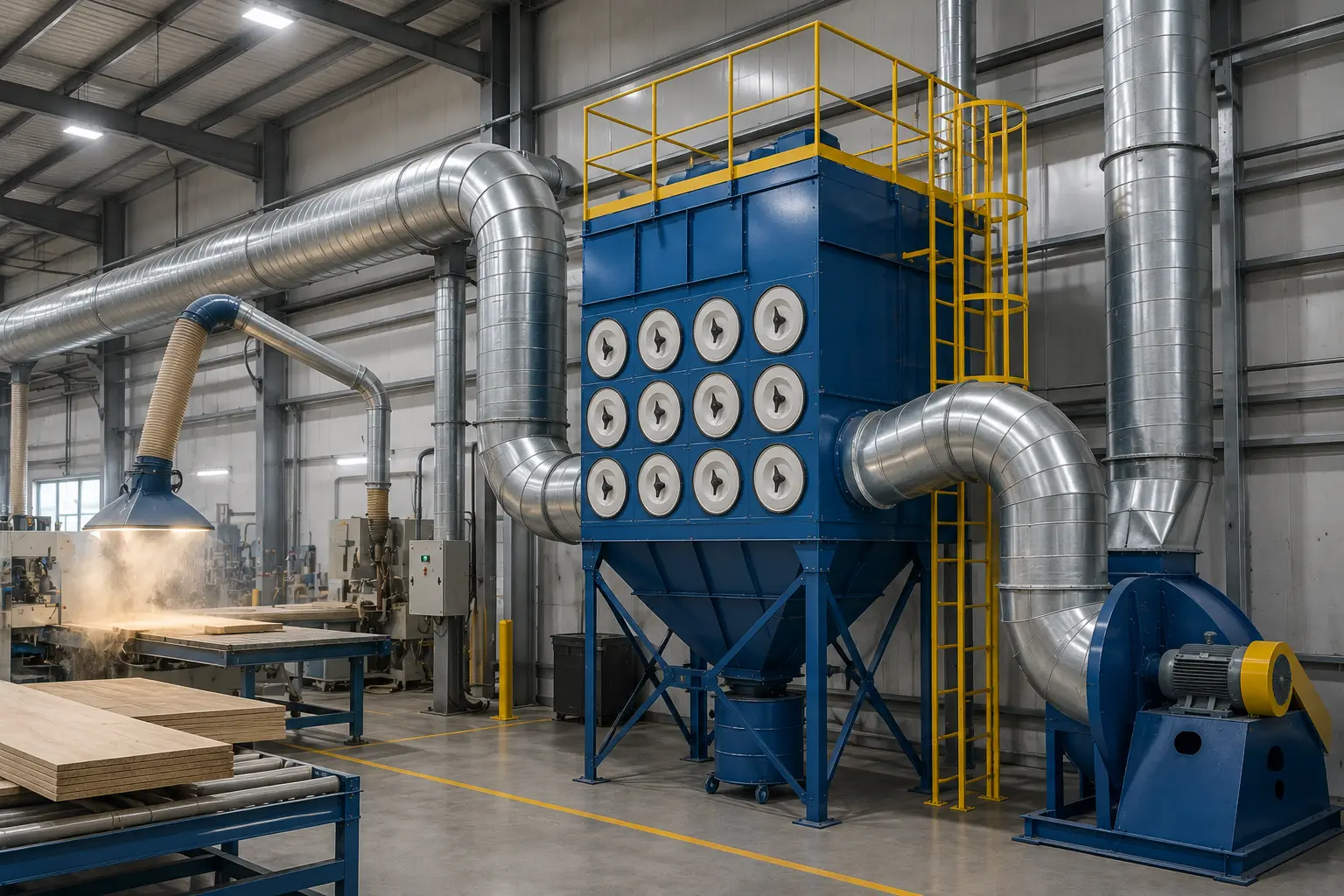
Industrial dust collectors capture dry dust particles generated during production processes.
They are widely used in industries where grinding, cutting, mixing, material transfer, or powder processing produces large quantities of airborne dust.
Dust collection systems help control particles before they spread throughout the facility.
Bag Filter Systems
Bag filters use fabric filter bags to separate dust particles from contaminated air.
As polluted air passes through the filtration media, particles are captured while cleaner air passes through the system.
Bag filtration is commonly used in industries requiring continuous dust collection.
Cartridge Dust Collectors
Cartridge dust collectors use compact pleated filter cartridges.
Their large filtration surface area makes them suitable for applications involving fine and lightweight dust.
They are often used in manufacturing plants where space efficiency and high filtration performance are important.
Fume Extraction Systems
Industrial processes such as welding, soldering, laser cutting, and metalworking can generate harmful fumes.
Fume extraction systems capture these contaminants close to the source before they spread into the surrounding work area.
Source capture can significantly improve workplace air quality.
Wet Scrubbers
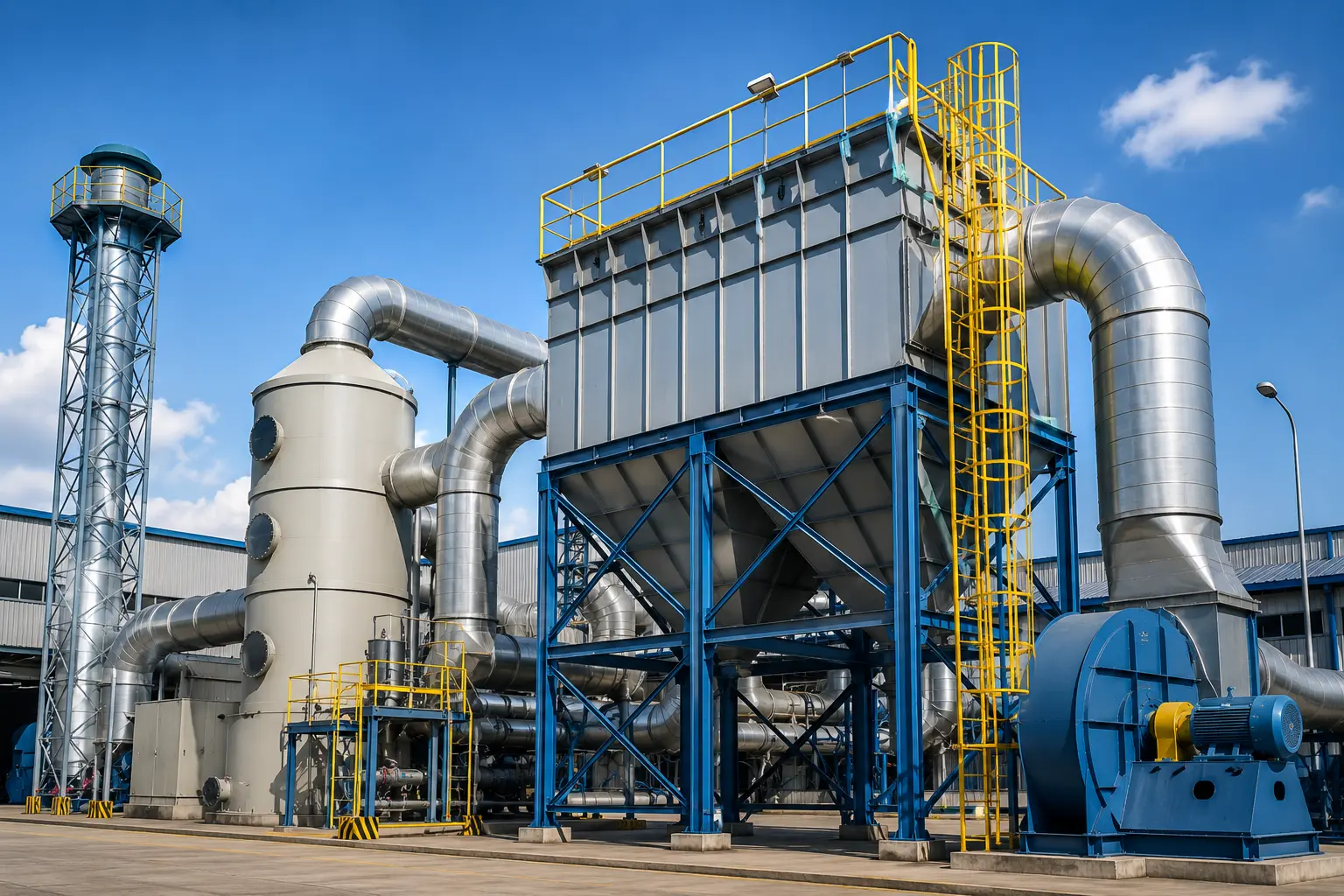
Wet scrubbers remove contaminants from industrial exhaust streams using liquid, generally water or another suitable scrubbing solution.
They can be useful where emissions contain gases, fumes, or particulate pollutants that can be effectively captured through liquid contact.
Cyclone Separators
Cyclone separators use centrifugal force to separate larger particles from an air stream.
They are often used as a pre-cleaning stage before finer filtration systems.
Removing larger particles before they reach filters can reduce the load on downstream filtration equipment.
How Does an Industrial Air Pollution Control System Work?
Although system designs vary, most pollution control systems follow a basic process.
Step 1: Pollutant Generation
Dust, fumes, gases, or particles are generated during an industrial process.
Step 2: Source Capture
Hoods, ducts, extraction arms, or enclosed collection points capture contaminated air as close as possible to the source.
Step 3: Air Transportation
The polluted air moves through ductwork with the help of an industrial blower or fan.
Step 4: Filtration or Separation
The air enters pollution control equipment such as a dust collector, scrubber, cartridge filter, or cyclone separator.
Pollutants are separated from the airflow.
Step 5: Clean Air Discharge
After treatment, cleaner air is discharged according to the system design and applicable environmental requirements.
Effective source capture is especially important because pollutants are easier to control before they spread throughout the production area.
How to Choose the Right Industrial Air Pollution Control System
Selecting the correct pollution control equipment requires a proper technical evaluation.
Several factors should be considered.
Type of Pollutant
First identify whether the process generates:
- Dry dust
- Fine particles
- Smoke
- Chemical fumes
- Oil mist
- Gases
- Moist contaminants
Different pollutants require different filtration technologies.
Airflow Requirement
The extraction system must provide sufficient airflow to capture contaminants effectively.
An undersized system may not remove pollutants properly, while an oversized system can increase energy consumption unnecessarily.
Particle Size
Large particles may be controlled using cyclone separators, while very fine particles may require cartridge filters, bag filters, or specialized filtration systems.
Operating Temperature
High-temperature industrial processes may require filters and system components designed specifically for elevated temperatures.
Available Space
Factories with limited installation space may require compact pollution control equipment or customized ducting configurations.
Maintenance Requirements
Filter replacement, cleaning cycles, dust disposal, inspection requirements, and access for maintenance should be considered during system design.
Benefits of a Properly Designed Pollution Control System
Installing the correct industrial air pollution control system can provide several operational benefits.
These include:
- Cleaner workplace air
- Reduced airborne dust
- Better working conditions
- Improved plant cleanliness
- Lower contamination of machinery
- Better visibility in production areas
- Easier housekeeping
- Improved environmental performance
- Better control of industrial emissions
- Support for regulatory compliance
A properly designed solution should also balance filtration performance, airflow efficiency, energy consumption, and long-term maintenance.
Industries That Need Air Pollution Control Solutions
Air pollution control equipment is used across a wide range of industries, including:
- Automotive manufacturing
- Metal fabrication
- Cement and construction materials
- Pharmaceuticals
- Chemicals
- Food processing
- Engineering
- Foundries
- Woodworking
- Electronics
- Paint and coatings
- Plastic processing
- Warehousing and material handling
Each industrial facility has different operating conditions, so pollution control solutions should ideally be designed based on actual site requirements rather than using a one-size-fits-all approach.
Importance of Proper System Design
Simply installing a dust collector does not guarantee effective pollution control.
The complete system must be designed correctly.
Important components include:
- Capture hoods
- Ducting
- Filters
- Blowers
- Airflow balancing
- Dust discharge mechanisms
- Control panels
- Monitoring systems
For example, even an efficient industrial dust collector may perform poorly if the capture hood is placed too far away from the pollution source.
Professional engineering and correct system integration are therefore essential.
Maintenance of Industrial Air Pollution Control Systems
Regular maintenance helps pollution control systems operate efficiently.
Important maintenance activities may include:
- Inspecting filters
- Cleaning filter elements
- Checking pressure drop
- Inspecting ducts
- Checking blower performance
- Removing collected dust
- Checking seals and connections
- Inspecting electrical controls
Facilities should maintain inspection and maintenance schedules based on operating conditions and equipment manufacturer recommendations.
Preventive maintenance can help reduce unexpected downtime and maintain consistent filtration performance.
Frequently Asked Questions
What is an industrial air pollution control system?
An industrial air pollution control system captures and removes dust, fumes, gases, smoke, and other contaminants generated during industrial operations before they enter the workplace or atmosphere.
Which industries require pollution control systems?
Manufacturing, metalworking, pharmaceutical, chemical, cement, automotive, woodworking, food processing, foundry, and many other industries may require air pollution control equipment depending on their production processes.
What is the difference between a dust collector and a scrubber?
A dust collector primarily captures solid airborne particles, while a scrubber uses liquid contact to remove certain particles, fumes, or gases from industrial exhaust.
How do I choose the right dust collection system?
The correct system depends on the type of dust, particle size, dust concentration, required airflow, process temperature, available installation space, and maintenance requirements.
Can pollution control systems improve workplace safety?
Yes. Capturing airborne contaminants close to their source can reduce employee exposure, improve visibility, reduce dust accumulation, and create a cleaner industrial working environment.
Conclusion
Modern industries need to balance production efficiency with worker safety and environmental responsibility.
An effective industrial air pollution control system helps capture dust, fumes, smoke, particles, and other harmful contaminants before they spread through the workplace or enter the environment.
However, successful pollution control depends on more than selecting filtration equipment. Proper source identification, airflow calculation, system design, installation, and maintenance all play an important role.
Bharat Air Technologies focuses on engineering-driven industrial solutions designed around practical operational requirements. Whether your facility needs dust collection, fume extraction, industrial filtration, or a customized air pollution control solution, choosing the right system can significantly improve plant cleanliness, workplace conditions, and long-term operational performance.
Looking for the right industrial air pollution control solution for your facility? Contact Bharat Air Technologies today to discuss your application and get a solution designed around your industry's actual requirements.
RECENT BLOGS